
Designing SARGE: Law Enforcement Software Built for the Field
uipirate
246 views · 10 min read
10 min read | 4 months ago
SARGE gives police officers real-time legal guidance, affidavit drafting, and tactical planning in the field. Here's how we designed AI that officers can trust.
What happens when an AI gets it wrong, and someone's freedom depends on the answer?
That's not a hypothetical for SARGE. It's law enforcement software that hands officers real-time legal guidance, probable cause analysis, affidavit drafting, Miranda compliance, and tactical planning, straight from a phone, often mid-incident.
"In most products, the cost of a mistake is frustration. In this one, the cost of a mistake is a lawsuit, or worse."
A hallucinated answer in a typical AI app wastes a few minutes. A hallucinated answer here can mean an unlawful search, suppressed evidence, or a case that collapses in court. This isn't a productivity tool. It's a decision-support system built to protect careers, convictions, and constitutional rights.
Why You Can't Be a Walking Legal Encyclopedia
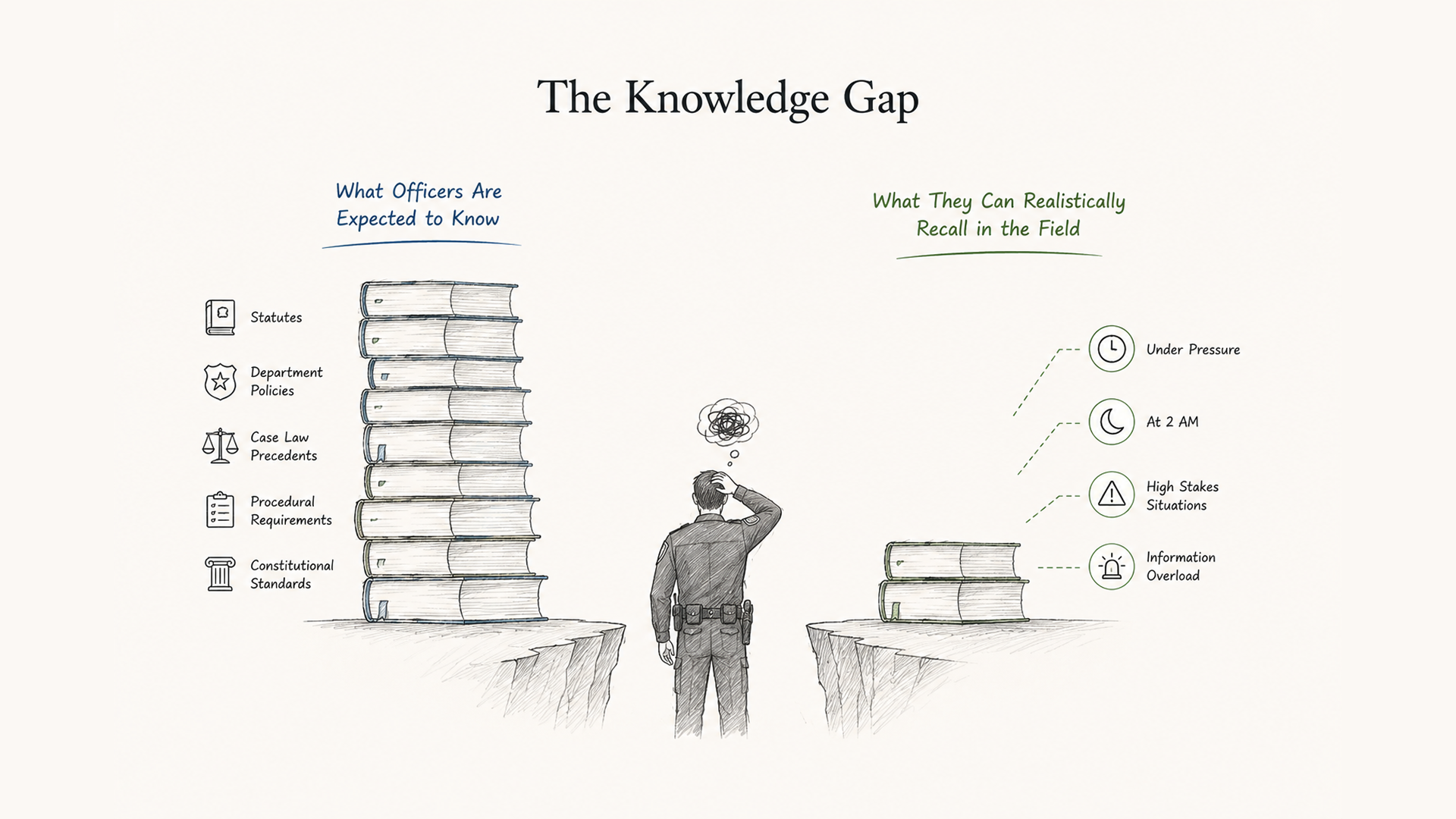
You're expected to recall, on the spot, with no notes:
The exact statute that applies
Your department's policy
Controlling case law
The constitutional standard at play
Nobody can do that consistently, especially not at 2 a.m. during a contested stop.
The founder behind SARGE spent years inside law enforcement and saw this gap firsthand. He had the legal expertise. What he needed was a product officers would actually reach for under pressure, one built to save you the guesswork that puts cases at risk.
Understanding How You Work in the Field
Before we touched a screen on this law enforcement software, we had to understand three things about how officers actually operate. Each one broke an assumption baked into typical legal tech.
It's an accountability problem, not a UX problem. Every decision had a second layer most products never face:
Not "is this helpful," but "is this legally defensible"
Not "is the UI intuitive," but "is it usable with gloves on, in the dark"
Not "does the AI feel smart," but "will an officer trust it during an arrest"
You think in scenarios, not statutes. Legal software organizes by code and citation. You don't. Standing beside a car, you're not thinking about statute 42.065, you're thinking "can I search this car?" So SARGE organizes everything by scenario, never by section number.
"Officers don't ask 'what statute applies?' They ask 'can I search this vehicle?' The entire product had to be built around that difference."
You operate under real stress. Arrests, uncooperative subjects, domestic calls, all in the dark or rain, often with gloves on. That ruled out small touch targets, multi-step navigation, dense text, and subtle UI cues. Every screen had to work for a trained professional under pressure, not a calm user at a desk.
Three Products, One System
This law enforcement software isn't a single app. It's three connected products, each built for a different moment in your day.
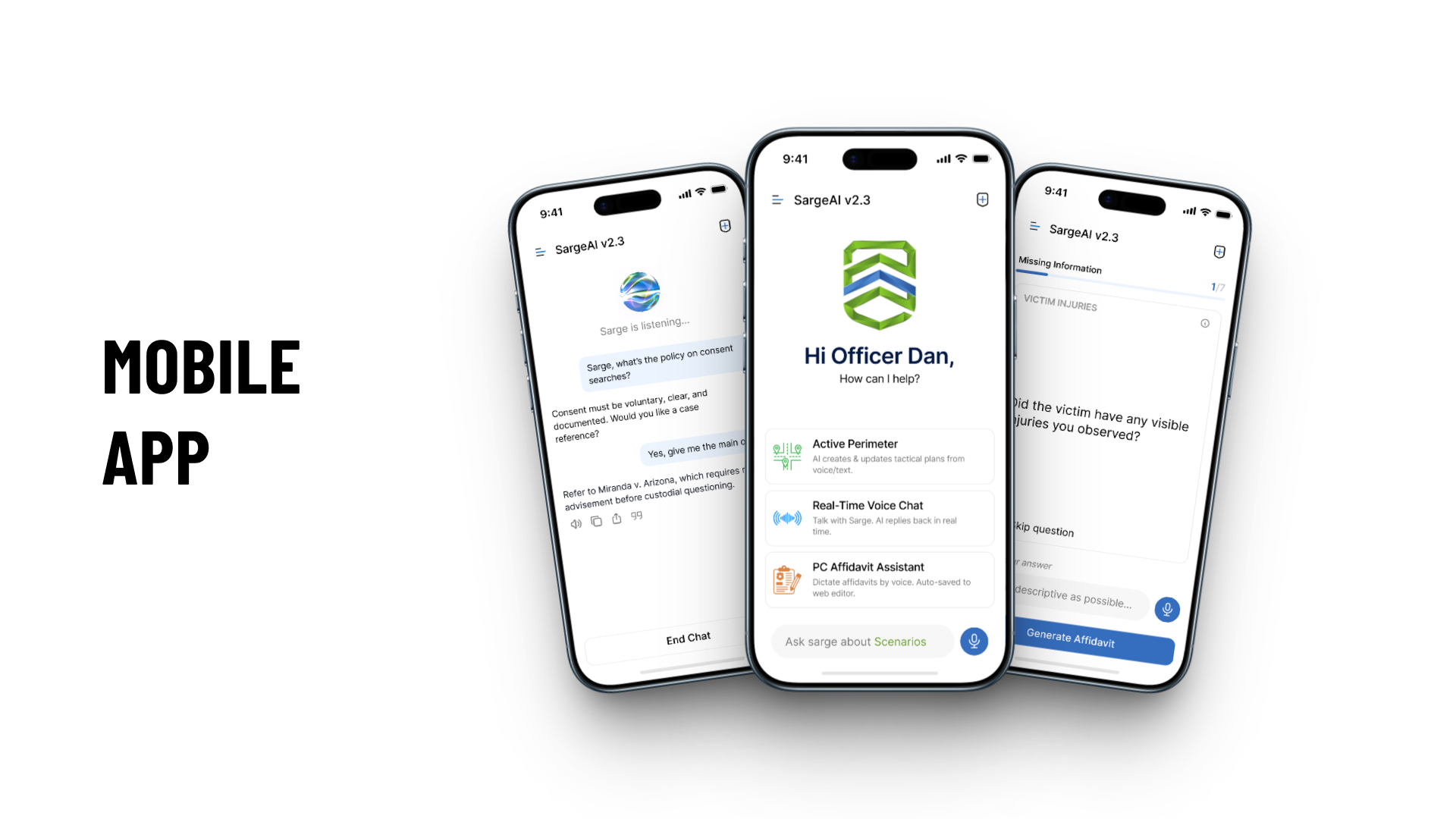
The Mobile App: Your Field Tool
The AI assistant, voice interaction, Miranda workflows, perimeter planning, and affidavit capture. Built to save you time and minimize taps under stress.
The Web Affidavit Editor: Your Desk Tool
Your desk tool: reviewing, editing, and finalizing AI-drafted affidavits after the fact. Built to improve accuracy and strengthen completeness.
The Marketing Website: The Trust Tool
The trust tool: built to grow department confidence in adopting AI, not to sell to an individual user.
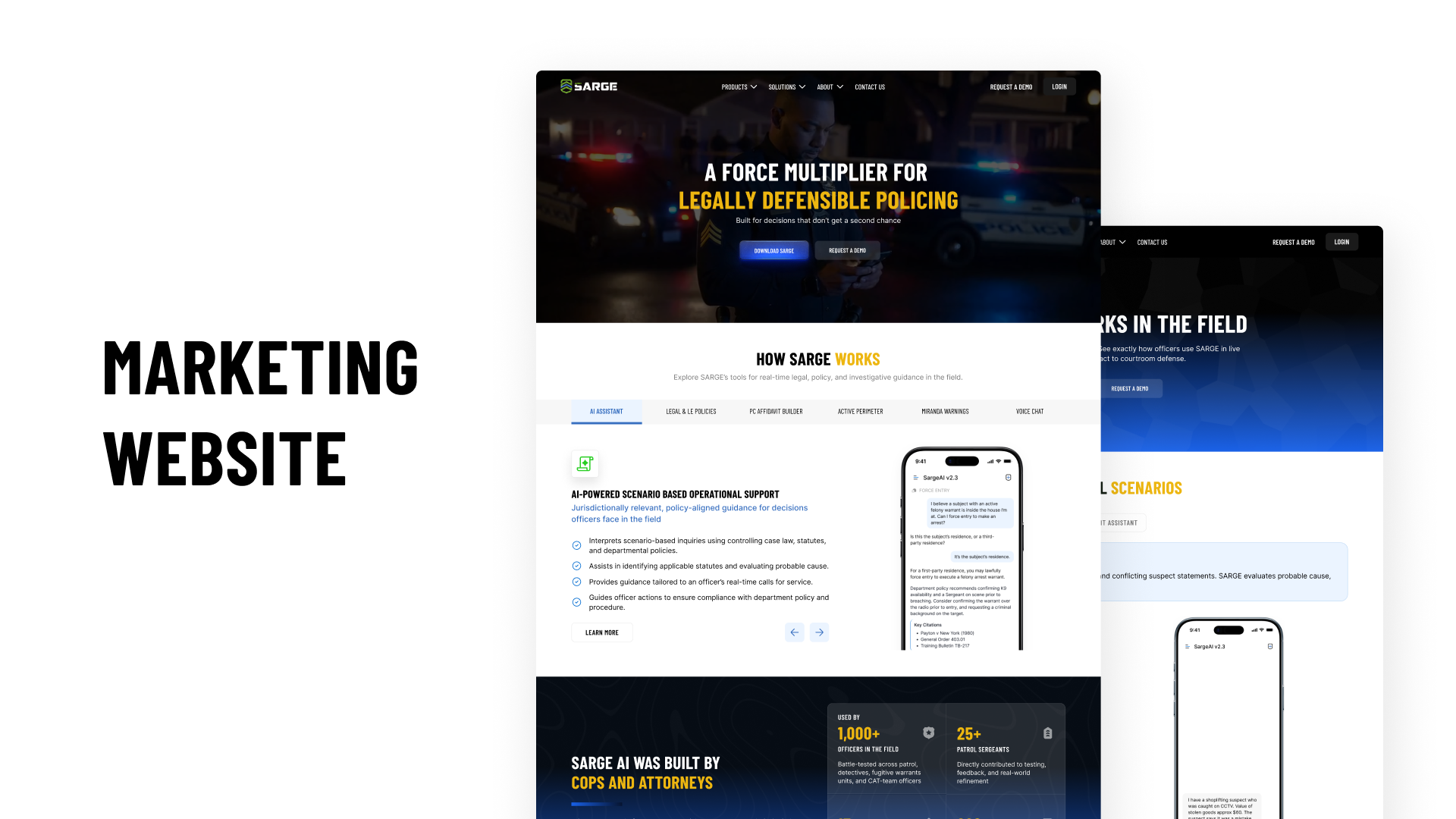
We treated these as one design language across three contexts. You shouldn't have to relearn how the product thinks when you switch from mobile to web.
Designing an AI Assistant You'll Actually Trust
At the center of this law enforcement software sits a conversational AI assistant. You ask a natural-language question, you get a cited, structured answer back. Simple to describe. Hard to build.
You need to trust the AI enough to act on it, but it can never look infallible. Too many disclaimers and you'll stop using it. Too much confidence and it creates liability, since legal questions hinge on jurisdiction and specifics that shift case to case. This had to sit in the narrow space between authoritative and honest.
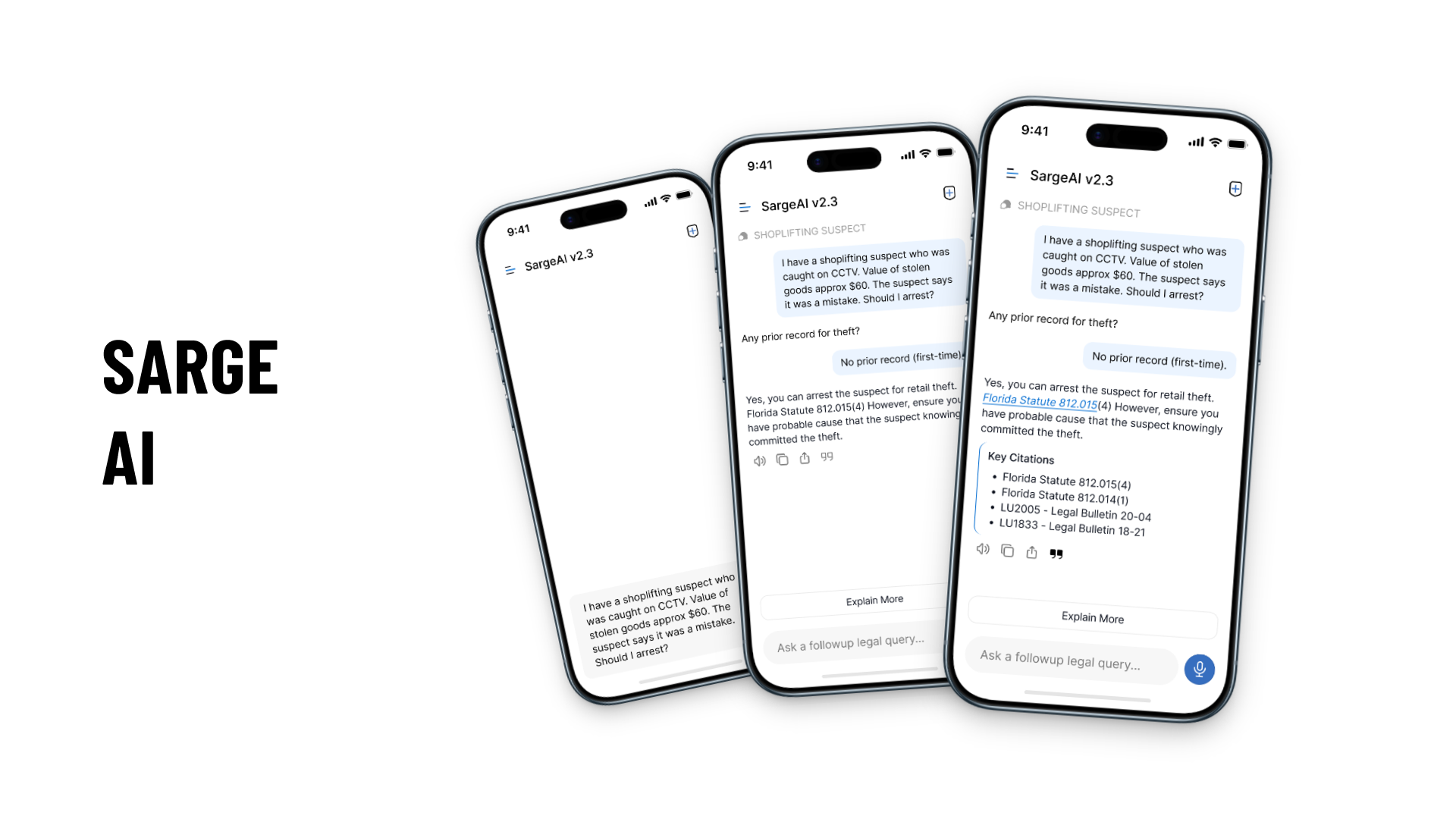
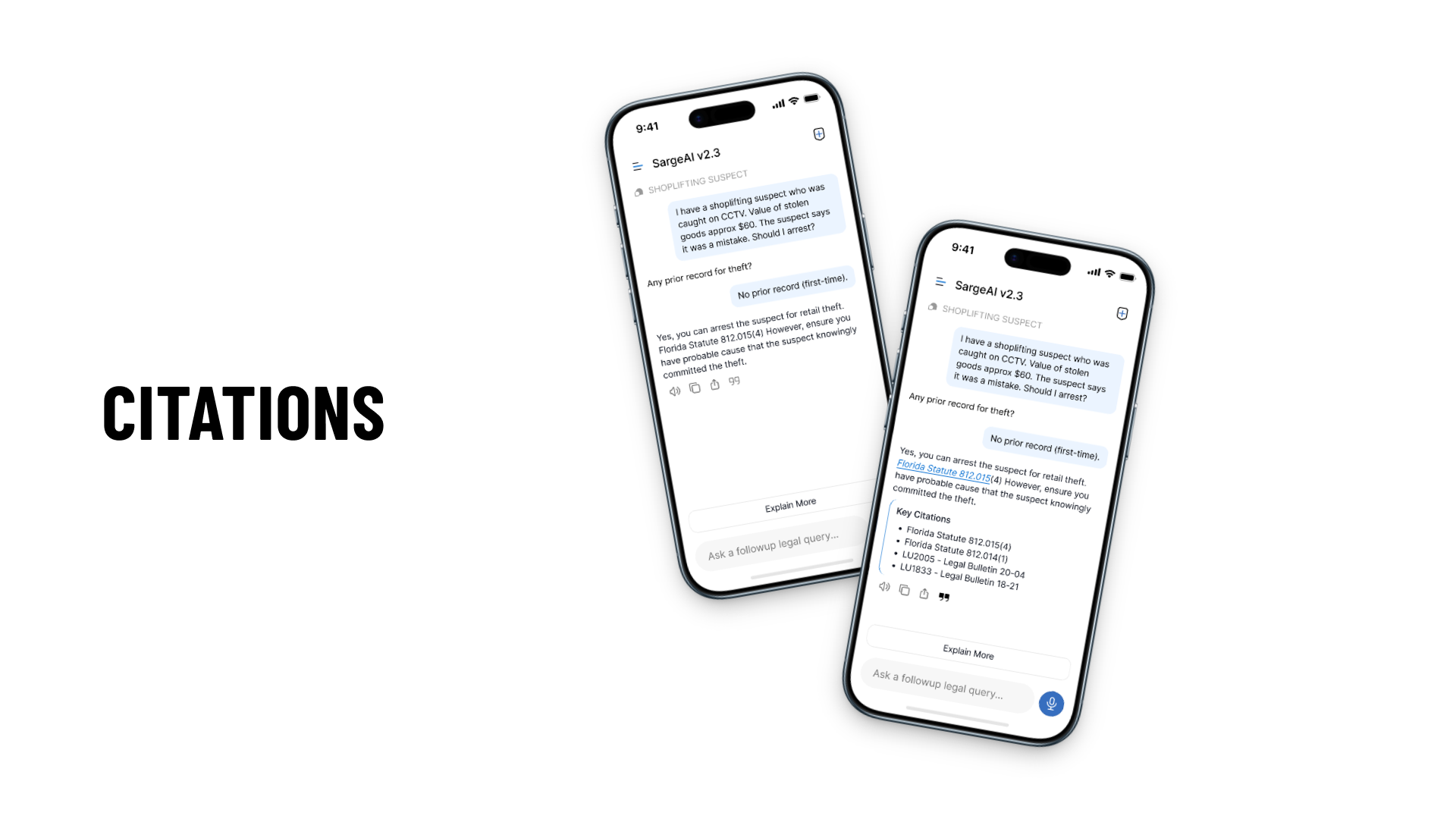
Our answer was citations. Every response surfaces its supporting authority:
The relevant statute
Controlling case law
Your own department policy
Current legal bulletins
The AI never says "you can search the vehicle." Instead, it names the statute, the case law, and the conditions that would support a search. This AI wasn't designed to look trustworthy. It was designed to prove trustworthiness, with every citation. Citations let you verify guidance, cite authority if challenged, and strengthen your case if it's ever questioned in court.
Designing for Liability Without Creating It
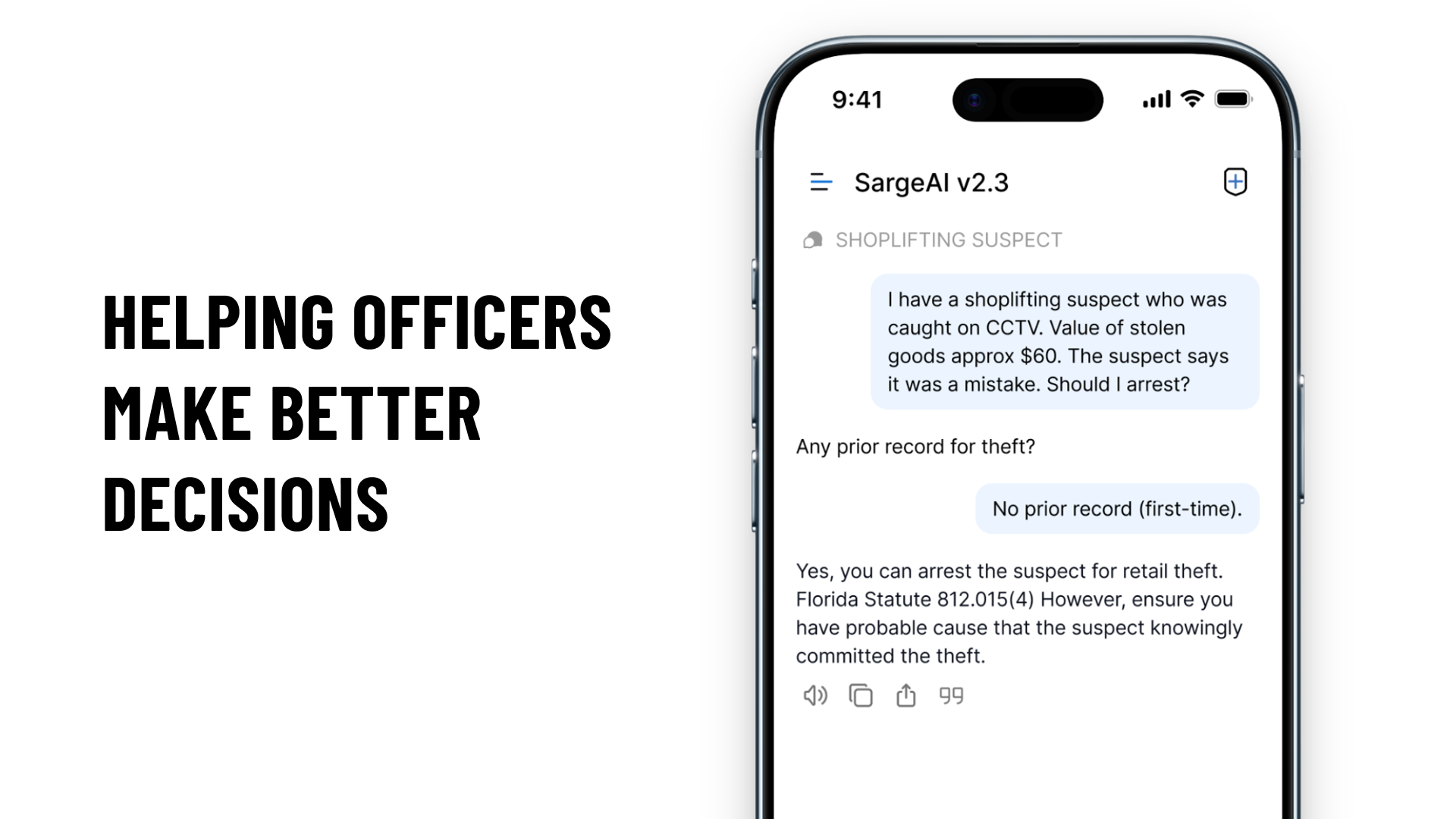
SARGE helps you make better decisions. It cannot make the decision for you, legally or practically. So the language throughout was calibrated line by line:
Instead of "You can arrest this suspect," it says "the following elements of probable cause may be present"
Instead of "This search is legal," it says "the following conditions support a lawful search"
The AI is your partner, not your commander. Every screen had to reinforce that, and to reduce the odds you're ever left guessing.
Voice First: Because You Can't Always Look at a Screen
Voice wasn't a nice-to-have here. It was survival infrastructure. Mid traffic-stop, you can't unlock a phone and type a question into law enforcement software. You need to speak it: "Can I search this vehicle if I smell marijuana but the driver says it's a legal CBD product?" SARGE's voice interaction handles:
Natural language input
Structured audio responses
Fully hands-free operation
Tolerance for roadside and ambient noise
Each of these saves you the seconds a manual lookup would cost.
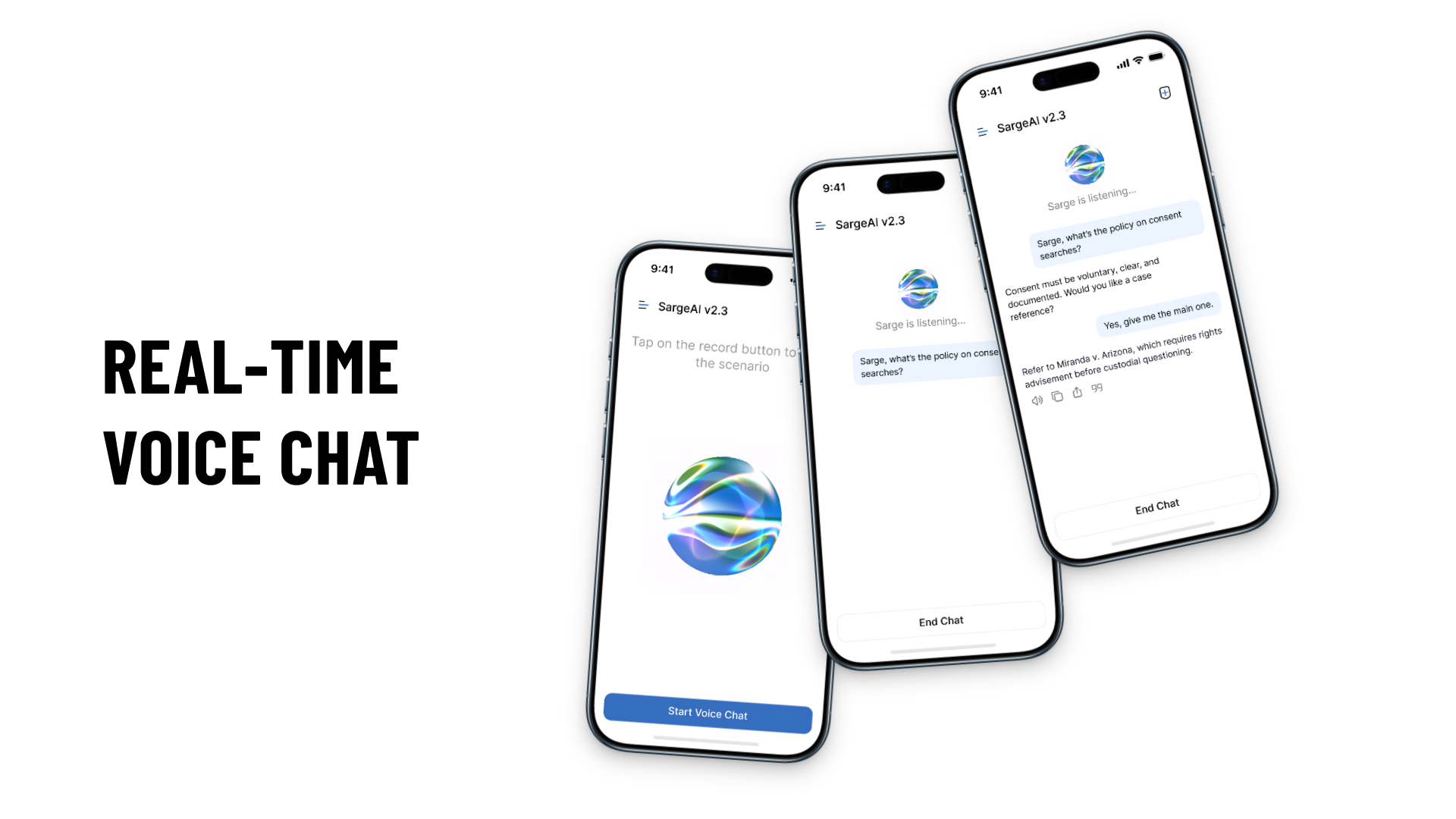
A cited answer on screen can be scanned and re-read. A spoken one gets one pass. So voice responses lead with the actionable guidance first. They follow with the legal basis, then offer depth only on request, something like "Would you like the case law?" Text could stay comprehensive up front. Voice had to be layered.
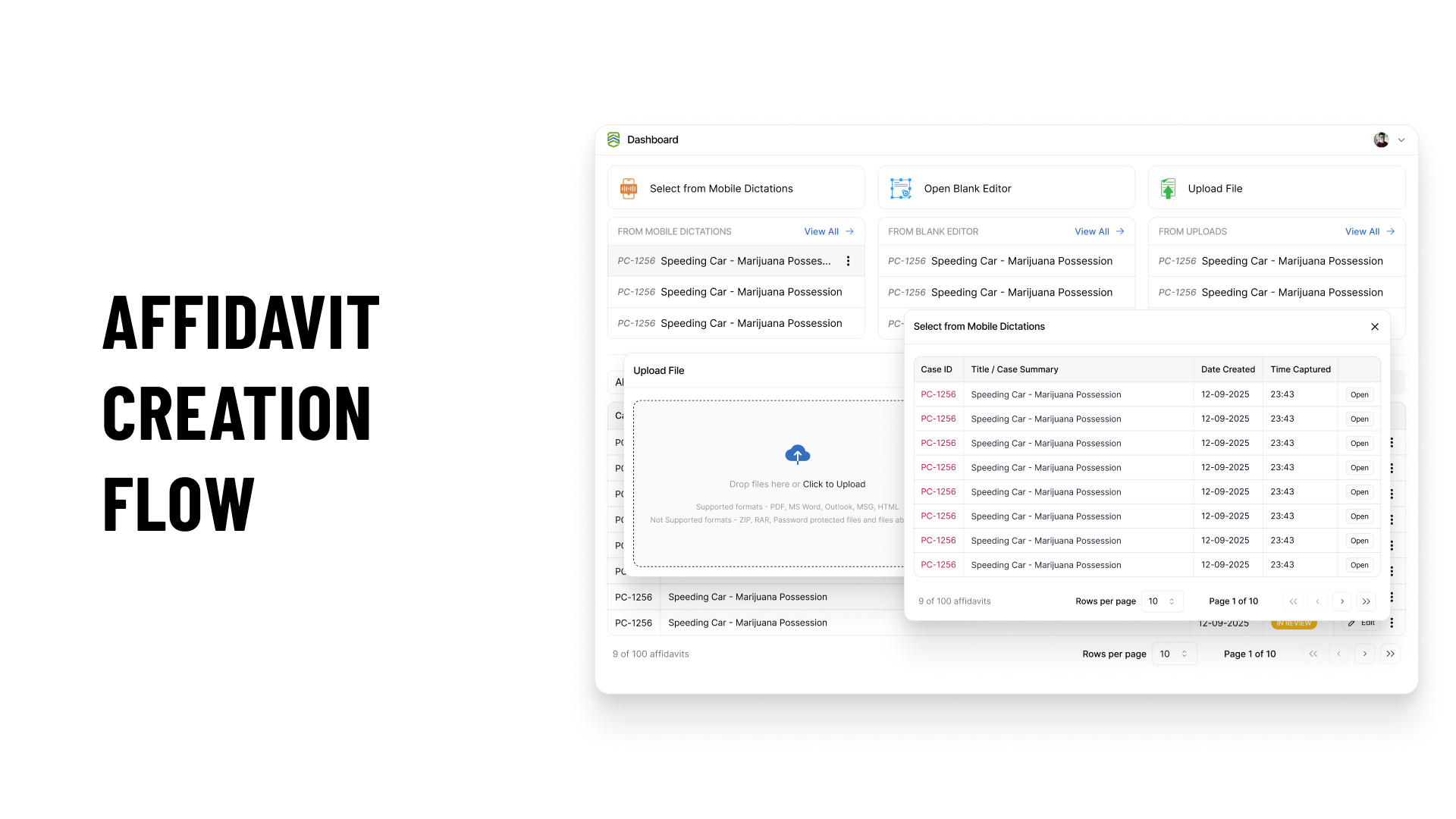
The Probable Cause Affidavit Builder
If the AI assistant is the brain of this law enforcement software, the affidavit builder is the backbone. A poorly written affidavit can get evidence suppressed or a case dismissed, and most officers were never trained to write one.
Instead of a blank page, you move through a guided flow:
Dictate the facts
The AI flags what's missing and asks only relevant follow-ups
It generates a structured draft
You review and approve
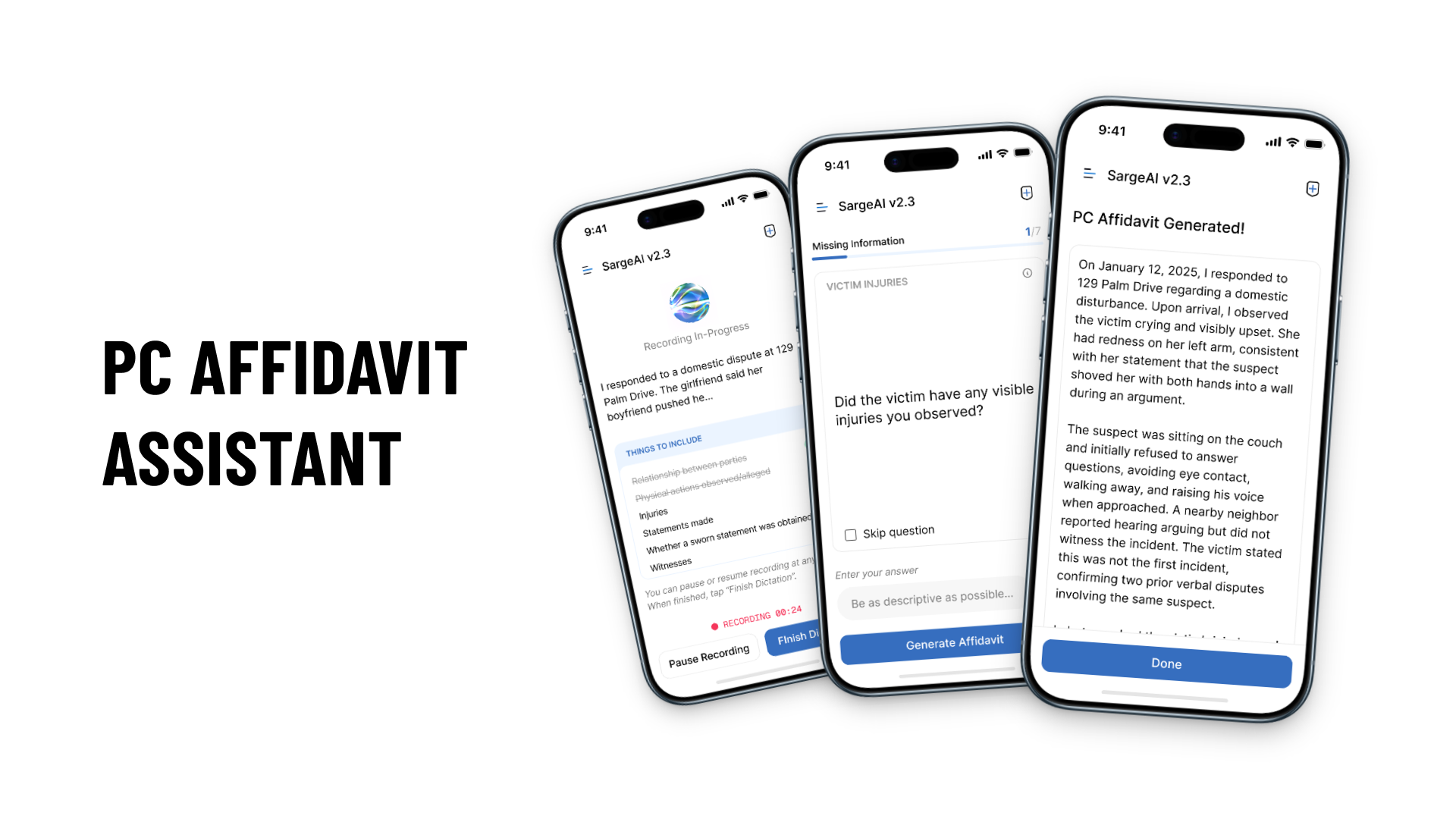
Fixed forms fail in both directions: too many irrelevant questions, or missed critical ones. SARGE reads your narrative and asks only what's missing for that specific incident, which helps you save time on paperwork without cutting corners on what the case needs.
"The affidavit builder didn't ask officers to fill out forms. It asked them to tell their story, then made sure the story was legally complete."
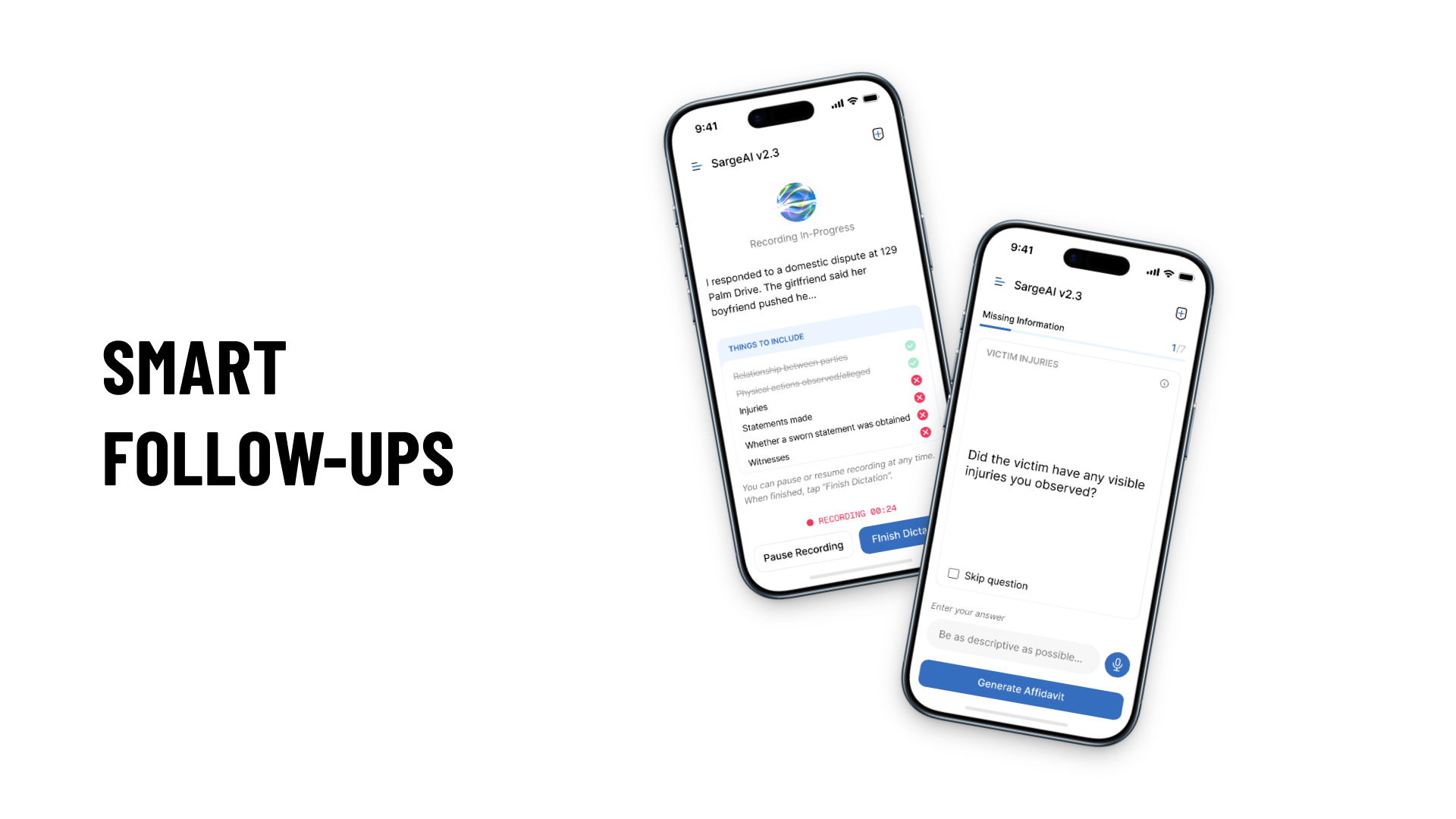
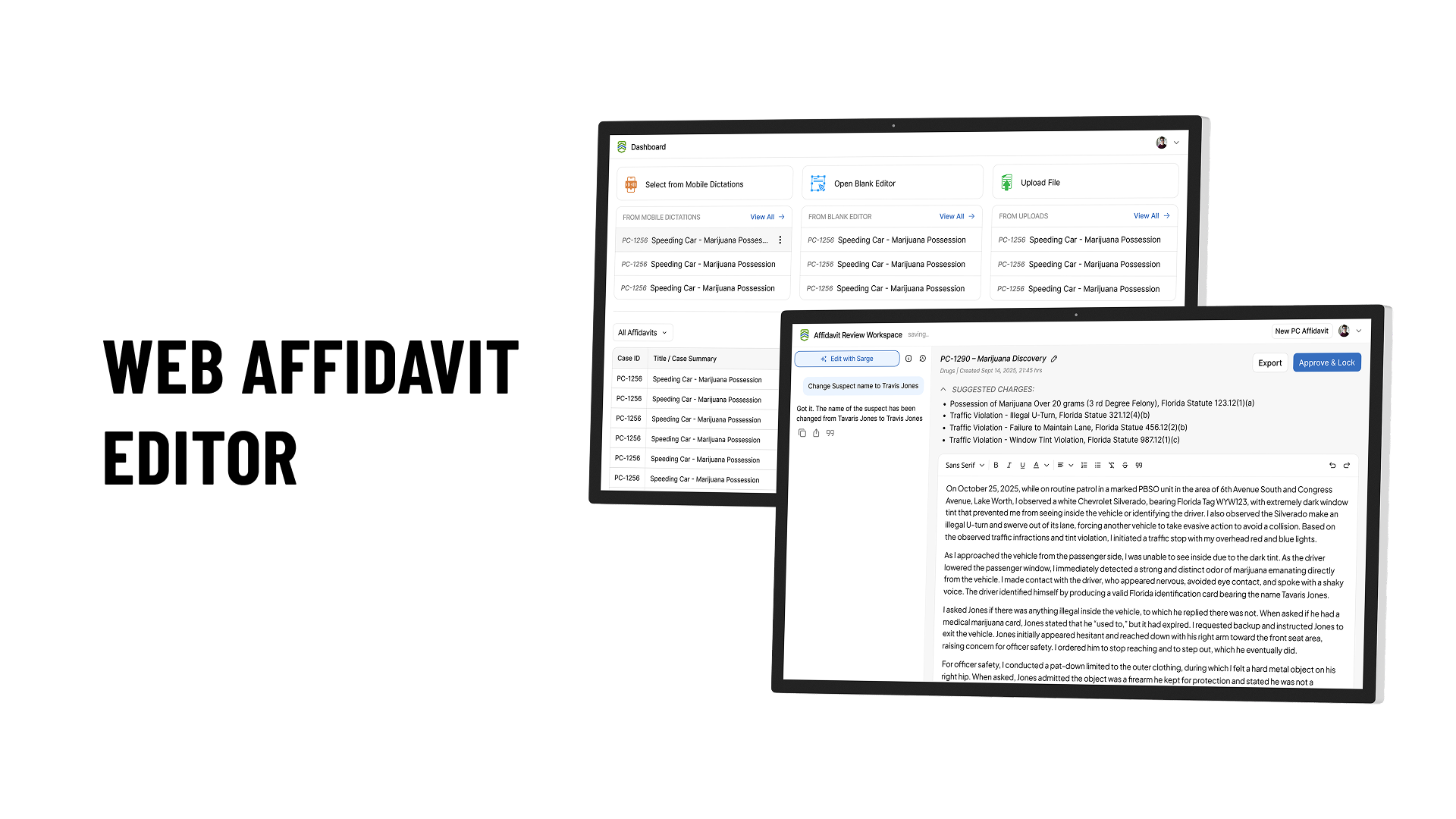
The Web Affidavit Editor
A field-drafted affidavit needs a second life on a bigger screen. The web editor gives you, your supervisors, and reviewers a precision environment:
Full-text editing with legal formatting preserved
AI-flagged weak spots
Version tracking on every change
Supervisory approval workflows
Export to court-ready PDF
Your mobile app captures the story. The web editor makes sure it holds up in court. That handoff is designed to reduce the odds a technicality costs you a conviction.
The Dynamic Perimeter System
This feature of the law enforcement software surprised us most. "Dynamic perimeter planning" sounded like drop a pin, draw a circle. It's far more layered. All at once, under pressure, you're calculating:
Last known location and direction of travel
Time elapsed and speed estimates
Suspect count and available units
Geographic obstacles and entry or exit points
SARGE takes the inputs you can realistically supply and generates a tactical perimeter that updates as new information arrives, helping you improve coordination across units in real time.
Miranda Compliance, Digitized
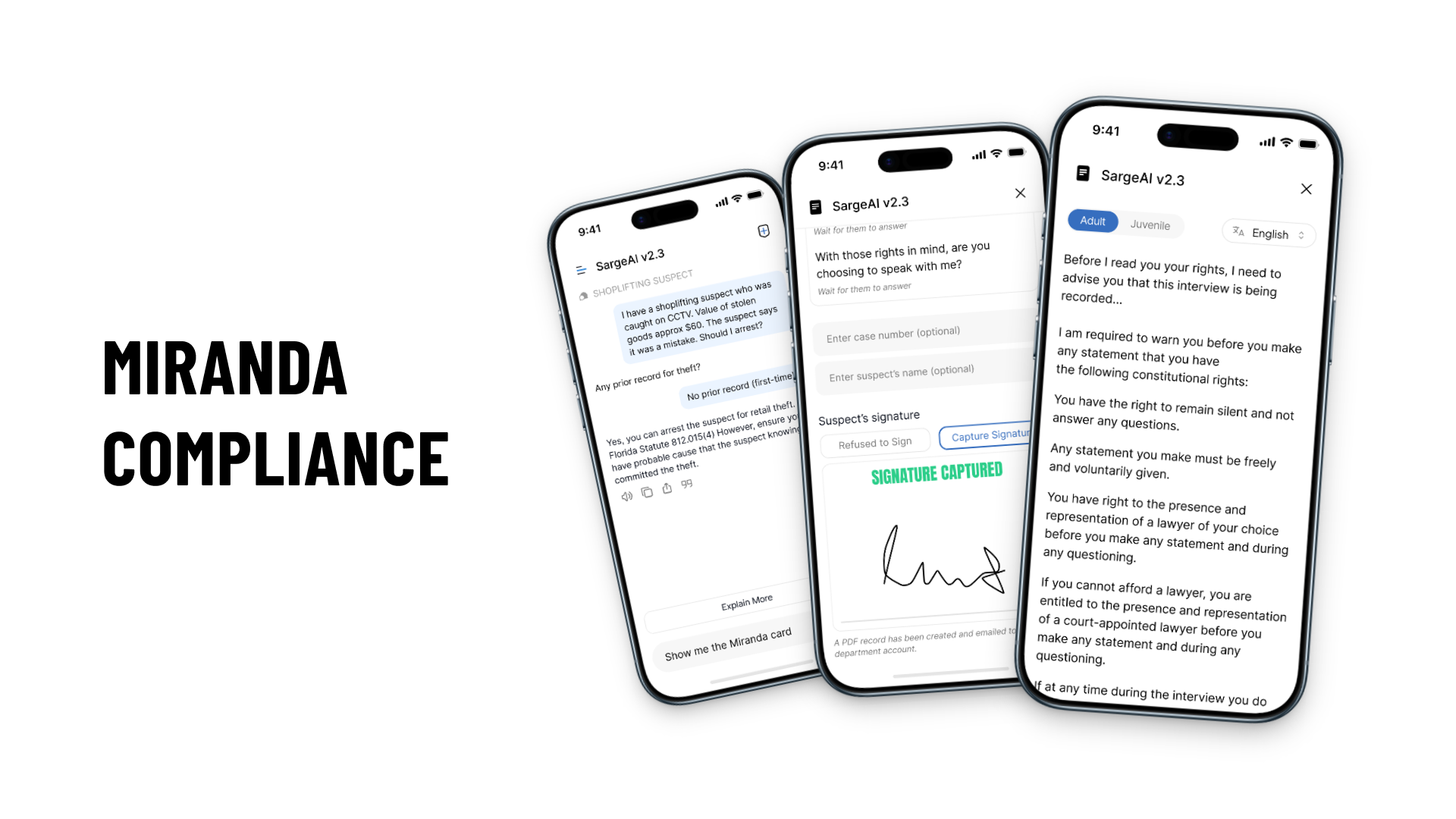
Get the language, timing, or documentation wrong on a Miranda warning, and statements can become inadmissible, a risk this law enforcement software was built to remove. Most departments still use laminated cards with no record the warning was given or understood. SARGE digitizes the whole workflow:
Adult and juvenile warning language
Multilingual support
On-device digital acknowledgment
Refusal documentation
Immediate court-ready PDF generation
"The Miranda feature will never make a marketing highlight reel. But it might save the most cases from being thrown out."
The Law Enforcement Software Visual System
We resisted every instinct to make this look like a typical AI product.
What we avoided:
Glowing gradients, which read as experimental
Playful illustrations, which trivialize serious subject matter
Chatbot personality, since SARGE is a system, not a character
Bouncy consumer-app patterns that signal "built for everyone," not "for professionals"
What we chose instead:
Institutional, professional authority over trendy AI aesthetics
High contrast, field-tested for sunlight, darkness, and smudged screens
Color that always maps to function, never decoration
Oversized touch targets for gloved or shaking hands
Minimal animation, because a 300ms fade feels slow under stress
The Component System Underneath
That same discipline shaped the components underneath this law enforcement software:
Citation cards, the atomic unit of trust
Status indicators covering every incident state
Custom map components built for tactical planning instead of navigation
Oversized inputs sized for gloves and urgency
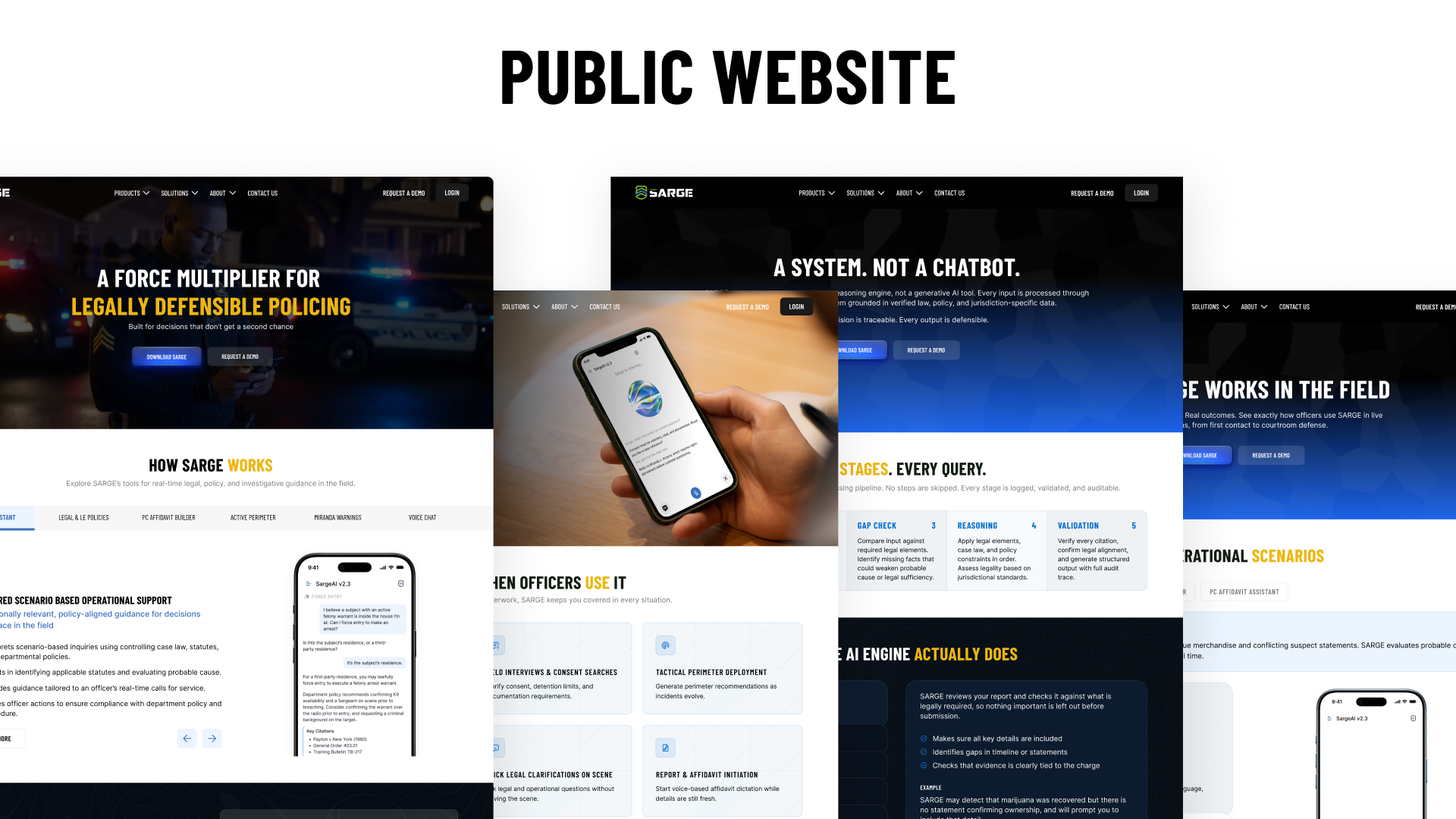
The Public Website: Selling Trust, Not Features
This site had a different job than most marketing pages. It's persuading risk-averse, procurement-heavy police departments to adopt an AI system for their officers, not selling to one user. You'll find it reads like a trust document: liability reduction, compliance standards, data security, and evidence defensibility, laid out clearly for the people who actually approve the purchase.
It includes product pages for mobile and web, solution pages for the AI engine and legal library, demo booking, resources, and legal pages. All of it is built to grow department confidence in adopting AI. It also has standalone QR-linked pages for chiefs of police, sheriffs, IT and CJIS staff, and command staff.
"The website wasn't designed to impress. It was designed to survive a room full of skeptical police chiefs asking hard questions."
What Made This Project Different
A few constraints made this law enforcement software unlike anything we'd designed before:
The liability razor. Every label and AI response sat between helpful and prescriptive. We spent more time on language than on visuals.
Skeptical users. Law enforcement culture doesn't trust tech promises easily. The product had to prove value immediately, with no learning curve.
No progressive disclosure. Your first real use might happen mid-arrest. No tutorials, no hidden features.
Two full response architectures. Voice had to carry the entire interaction on its own, not just serve as an input method.
The follow-up problem. Smart questions had to gather what was legally needed without feeling like an interrogation.
What stuck with us afterward: design here carries weight beyond the screen, since it affects whether you make a lawful call and whether a case survives court. Trust isn't a feature, it's the sum of every interaction, one built to protect officers and improve outcomes for everyone the decision touches. And language became our primary design material, since the gap between "you can" and "conditions may support" is the gap between guidance and liability.
What SARGE Became
As a piece of law enforcement software, SARGE doesn't sit neatly in one category. It isn't a chatbot, a legal database, or a tactical tool on its own. It's a decision-support ecosystem, giving you legal knowledge, procedural guidance, and documentation tools exactly when you need them, built to hold up under the worst conditions.
Every answer needs a source. Every interaction needs to be defensible. The design itself becomes part of the evidence for whether the system helped you protect a case, save time, and improve a decision made under pressure.